Piano Brands Explained: Origin, History and Status Today
Piano brands disappear, merge or change hands without any of it showing on the instrument. A name on the fallboard often tells you very little about who actually built the piano, or whether the company behind it still exists. Some names never stood for a factory at all. This guide walks you through finding information on a brand step by step, shows what became of well-known makers, and tells you how to spot who is really behind a name today.
Four steps to identifying the maker
These four steps work for practically any brand, from a maker still in mass production to a workshop that closed ninety years ago. Work through them in order, and you'll usually have your answer by the second one.
- Read the name plate and serial number: The starting point is always the name on the instrument, usually above the keys or inside on the cast iron plate. Write the brand name down exactly as it appears, including additions like a city or an award, and note the serial number alongside it. How to read a serial number correctly is covered in our guide to serial numbers and build year.
- Look the brand up in a specialist archive: General reference works cover almost only makers large enough to be known beyond their own region. For everyone else you need an archive that has worked through trade journals and commercial directories specifically for company histories. Which sources are worth using is covered in the research sources section below.
- Ask a piano technician near you: Experienced piano builders and tuners in your area often carry decades of knowledge about local workshops that appear in no database, simply because they were never big enough to be known further afield. If you're having the instrument tuned anyway, just ask during the appointment.
- Ask in forums and communities: pianoworld.com is the largest English-language piano forum, with plenty of experienced collectors who have likely dealt with obscure brands before. A photo of the name plate and the cast iron plate usually gets you an answer faster than a text-only question.
When the name was never a factory: stencil pianos
A good share of the names on old pianos never belonged to a manufacturer. Department stores, mail-order companies and larger piano dealers had instruments built in someone else's factory and put their own name on the fallboard. The trade calls these stencil pianos. If you can't find anything at all about a name, this is often why.
- How to spot a stencil piano: A clear sign is a name that appears in no maker directory even though the instrument itself is cleanly and industrially built. The actual builder is often given away by the action, which usually carries its supplier's stamps, or by a construction that matches a known maker of the same period.
- The practice is still alive: Current brands are handed out the same way. Boston is Steinway & Sons' second brand and is built by Kawai, Essex is Steinway's entry line made by Pearl River.
- What this means for value: A stencil name is not a verdict on quality. Some of these instruments came out of very good factories and are cheaper today only because there's no famous name on the lid. What decides the price is the inspected condition, not the origin of the lettering.
Why defunct brands are the hard cases
With active makers like Yamaha or Steinway & Sons the research is straightforward, the company still exists and curates its own history. With brands that are gone, three problems come together:
- Names get sold, factories don't: When a workshop closes, the brand name often survives as a tradeable asset. It ends up with another manufacturer who revives it years later for a completely different product line, usually in another country. So the name on its own tells you nothing about where your instrument was actually built.
- Wars and relocations destroyed the records: European piano building took two hits. Factory buildings and the paperwork inside them burned in the Second World War, and the firms that survived were often expropriated, relocated or merged into larger combines afterwards. Company records were pooled, moved or simply thrown out along the way. That's why the trail for many makers goes cold in exactly the decades that would tell you the most.
- Small workshops left almost no trace: Many firms were never large enough to make it into national directories. Their instruments are often solidly built, but the company appears in no standard reference work. Names like that only turn up in archives that have systematically worked through commercial directories and trade journals.
What became of well-known brands
This overview uses eleven examples to show how differently a brand's path can run. The third column gives the year in which no more instruments were built under the original company. The brand name itself can carry on after that, often somewhere else entirely. Where production still happens, the last column says where.
Some of these brands have listing pages of their own on PianoHub: Ibach, Ritmüller, Pleyel, Grotrian-Steinweg, Feurich, Zimmermann, W. Hoffmann.
Four brands in detail
The table only gives the outcome. These four examples, from a large industrial maker down to a small workshop, show how differently the paths to it can run:
- Gebr. Zimmermann (Leipzig): Founded in 1884 by the brothers Richard and Max Zimmermann, the firm grew by its own account into Europe's largest piano maker by 1909, with around 14,000 pianos a year and 1,600 staff by 1914. It merged with Ludwig Hupfeld AG in 1926 and was nationalised after the war. The brand carried on in Seifhennersdorf until C. Bechstein took it over in 1992.
- Friedrich Prein (Cologne): A far smaller operation: Prein built pianos in Cologne around 1900 and even registered his own patent for a soundboard bridge. Instrument production probably ended around 1932/33. Small workshops like this are exactly the case where a specialist archive earns its keep, since the standard histories of piano building often don't list them at all.
- Ritmüller (Göttingen): Founded in 1795, its company house in Göttingen even received Johannes Brahms as a visitor. After bankruptcy in 1890 and several changes of owner, production ended in 1933. Since 1997 the brand name has belonged to the Chinese maker Pearl River, and today's Ritmüller pianos are built in Guangzhou, sharing nothing but the name with the historical Göttingen workshop.
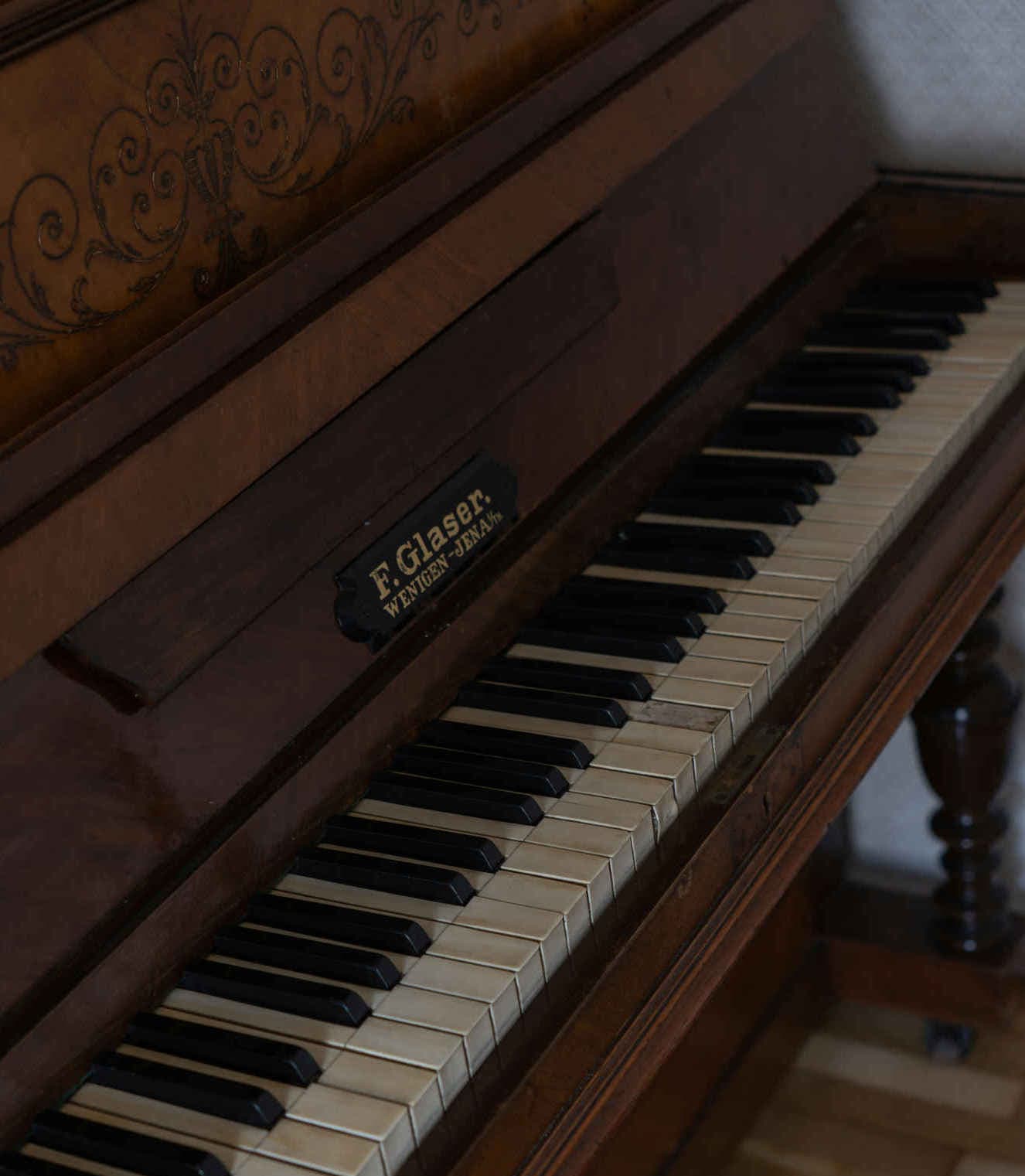
- F. Glaser and Gebr. Glaser (Jena and Roda): With Glaser, two factories of almost the same name ran side by side. Franz Glaser built pianos in Wenigenjena near Jena from 1887, after the predecessor firm Glaser & Bachstein broke up, and stayed active until around 1913. His three sons left in 1910 and founded Gebr. Glaser the following year in Roda, today Stadtroda in Thuringia, which produced until about 1938. Both sides stated expressly in the Zeitschrift für Instrumentenbau that the two businesses had nothing to do with one another. So a plate that just reads "Glaser" gets you nowhere, only the exact wording including the town tells you which factory built the instrument. On quality the contemporary voices diverge. Franz Glaser himself served the cheap end of the market deliberately, by his own account. A dealer, on the other hand, accused him in 1897 of using inferior materials at the corners beside the soundboard.
Recommended sources for researching piano brands
- Dieter Gocht's extensive archive: Dieter Gocht has spent decades documenting the history of German piano factories, and regularly writes the 'Historisches' column for the trade magazine Europiano. His site, dieter-gocht.de, is organized alphabetically by company name, free to use, and draws on sources like the Zeitschrift für Instrumentenbau (1880-1943) and international trade directories from 1886 to 1929. Just look up the brand name in his chronicle list, and if you don't find it, you can contact him directly.
- Japanese piano brands: For Japanese brands, Pianotuner.jp is a good starting point, it maps many brand names to their actual manufacturer. A full overview with more sources is in our guide to Japanese piano brands.
- American piano brands: For American brands, the American Piano Manufacturers Index from Sweeney Piano is a rich free source. More on that, including a historical chronicle and further archives, is in our guide to American piano brands.
The site is in German, but since it covers German brands in far more depth than anything else available, and German makers dominate the vintage market worldwide, it's worth reading anyway. Your browser's built-in translation feature (for example in Chrome) handles it well enough to follow along.
The forum mentioned above is also worth checking, especially if other owners have already dealt with the same brand.
Frequently asked questions
How do I tell whether my piano really comes from the historical maker?
Check the serial number and the name plate, then compare where and when the instrument was built according to them. For some brands the place of manufacture already settles it: Ritmüller pianos from the Göttingen workshop ended in 1933, the name has belonged to Pearl River since 1997 and today's instruments come from Guangzhou. W. Hoffmann is a similar case, the brand started in Berlin in 1893 but is built today in Hradec Králové in the Czech Republic.
What does it mean for a piano's value if its brand no longer exists?
Not much on its own: a piano's value mainly comes down to condition, sound, size, and build quality, not whether the manufacturer still publishes a current catalog. For some discontinued brands, rarity can even push value up, since no more instruments are being made. What you do lose without an active manufacturer is a direct point of contact for spare parts or an official assessment, which makes an independent inspection by a piano technician even more valuable.
Are old, unknown piano brands automatically worth less?
No. How well-known a brand is is just one factor among several. A carefully built, well-maintained instrument from an obscure workshop can easily match better-known brands in sound and quality, while a neglected instrument from a famous brand loses value fast. What ultimately matters is the instrument's actual condition, not just the name on the nameplate.
There's a name on my piano and I can't find anything about it at all. What now?
It's often a stencil name: a brand a department store or piano dealer had put on instruments from someone else's factory. The actual builder is frequently given away by the action, which usually carries its supplier's stamps. A piano technician can judge this with the instrument opened up, and many trade names have already been matched to their makers in forums.
How do I find out who owns a brand name today?
Start with the brand's own website, if there is one, and look at where it says the instruments are built. When a name has changed hands, that page usually credits the current parent company, since a group has no reason to hide it. Where no site exists, a trademark register shows the current holder, and dealer catalogues tell you which factory a brand's current models come from. The overview above already traces this for eleven brands.
There's a year on the cast iron plate. Is that the build year?
Usually not. The number on the plate is nearly always the company's founding year or the year of an award, not the year your instrument was made. The only reliable figure is the serial number, checked against the maker's number list.
Once you've identified your brand, the next step is usually pinning down its exact age via the serial number and getting a realistic valuation.
Or take a look at what pianos and grand pianos are currently listed on PianoHub.