Piano Pedals: What They Do and Who Needs Them
A grand piano usually has three pedals. Uprights are different: older instruments in particular often have only two, like the ones in the cover photo. With two pedals, they are almost always the damper pedal on the right and a pedal on the left that makes the sound softer. What sits in the middle when there are three depends on the instrument: usually a sostenuto pedal on a grand and a moderator on an upright. This guide explains the mechanics behind each pedal, what you hear when you press it, and who really benefits from which pedal.
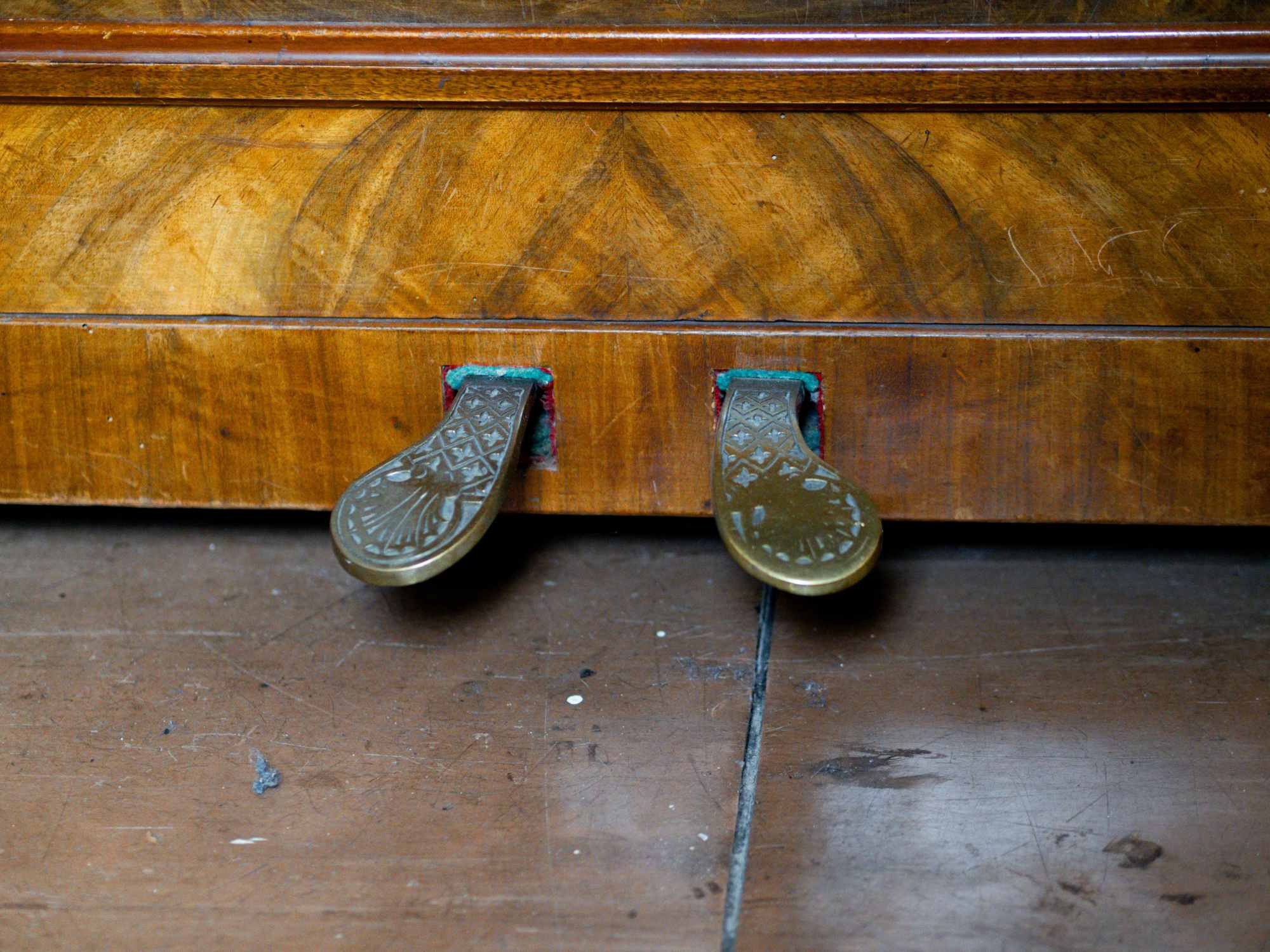
The Pedals at a Glance
On the two outer pedals, upright and grand end up doing much the same thing. Only in the middle do they part ways.
- Right pedal (damper pedal): The same on every upright and grand: it lifts all the dampers off the strings so the notes keep ringing.
- Left pedal (softer and gentler): The sound becomes quieter and softer. On a grand this happens by shifting the action sideways (una corda), on an upright by shortening the hammer travel (soft pedal). The mechanism differs, the result is similar.
- Middle pedal (depends on the instrument): On a grand usually a sostenuto pedal, which holds only the notes already played. On an upright usually a moderator, a felt strip that makes the sound much quieter. Many older uprights have no middle pedal at all.
A pedal in the middle tells you nothing about its function by itself. Whether it is a moderator, a bass sustain or a true sostenuto only shows when you try it or in the manufacturer's specifications.
Right: The Damper Pedal
The right pedal is the one you use most. At rest, a felt damper lies on each string and ends the note as soon as you release the key. When you press the pedal, all the dampers lift at the same time.
- What you hear: Notes keep sounding after you release the key. All the other free strings also vibrate along (resonance), so the sound becomes fuller and less clear.
- Half pedaling: Half pedaling is not a separate pedal but a way of playing the damper pedal. The pedal travel is continuous: if you press it only part of the way, the dampers still rest lightly on the strings and damp only partly. Pianists use this to let sounds blend softly without everything blurring. In the high register a lightly resting damper works more strongly than in the low register.
- Other names: Sustain pedal, damper pedal, forte pedal or right pedal: it always means the same pedal.
- Grand and upright: On a grand the dampers rest on the strings from above, on an upright springs press them against the strings from the side. The effect when you press the pedal is the same.
Left: Una Corda on a Grand, Soft Pedal on an Upright
The left pedal makes both instruments quieter, but in different ways. The Italian term “una corda” only fits the grand, because nothing shifts on an upright.
- Una corda on a grand: The pedal shifts the whole keyboard and action a little to the side. As a result the hammers hit only two strings on notes with three strings, and only one on notes with two strings in the tenor and bass. The name literally means “one string”: on historical instruments the shift could go so far that only one string per note was struck.
- Sound on a grand: The sound becomes quieter and changes its character: gentler, slightly veiled. One reason may be that the hammers strike a less used part of the felt. So it is not a pedal that merely makes things quieter.
- Soft pedal on an upright: On an upright nothing shifts. The pedal moves the hammer rail closer to the strings, so the hammers travel a shorter distance and strike with less momentum. The sound becomes quieter and softer, but it changes its color less than on a grand.
- Touch: With the soft pedal pressed, the keys feel lighter and slightly less precise, because the hammers travel a shorter distance.
- In the sheet music: The score usually says “una corda” for pressing and “tre corde” or “tutte le corde” for releasing. Beethoven asks for it explicitly in his late sonatas, Debussy in many pieces.
In the Middle: Sostenuto, Moderator or Something Else
The middle pedal is where upright and grand differ most. So it pays to judge it not by its position but by what the pedal actually does.
- Sostenuto pedal on a grand: The sostenuto pedal holds only the notes whose keys you have already pressed when you press the pedal. A bar catches the matching dampers, and those notes keep sounding. Everything you play afterwards is damped normally. That lets you hold a low bass note or chord while both hands play short notes higher up.
- Origin of the sostenuto: Boisselot presented a forerunner in Paris in 1844, and Steinway patented today's mechanism in 1874. European makers adopted it only hesitantly, which is why some older grands lack the pedal.
- Moderator on an upright: The moderator slides a felt strip between the hammers and strings. The sound becomes much quieter and duller, so you can practice without disturbing the neighbors. That is why it is also called a practice pedal, or “celeste” in English. As a pedal it usually locks in place: you push it down and sideways, and the felt stays engaged, leaving both feet free for the other pedals.
- Other setups on an upright: A bass sustain lifts only the dampers in the bass, so low notes keep ringing while short notes are played in the treble. A true sostenuto as on a grand is very rare on an upright. Sauter, for example, offers one on its Meisterklasse uprights. On some older uprights the middle pedal does nothing at all.
- Moderator or sostenuto: An instrument usually has either a moderator or a sostenuto pedal, because both compete for the same spot in the middle. Having both is very rare.
Extra Mechanisms: When the Moderator Is Not a Pedal
Not every function that changes the sound sits on a pedal.
- Hand lever and pull cable: On some uprights the felt strip is engaged not with the foot but with a hand lever or a pull cable. The effect is the same as with a moderator pedal.
- Knee lever and sordino: Steingraeber builds a “sordino” into its grands: a thin felt slides horizontally between hammer and string to create tone colors like those in historical scores. According to the manufacturer it can be engaged with the middle pedal, a knee lever or a fourth pedal.
- Silent system: On instruments with a silent system, a rail catches the hammers just before they reach the strings, sensors register the touch and the sound comes through headphones. The system is often switched on with a lever or the middle pedal. Some systems even have sensors that detect half pedaling. More in the guide Digital piano or acoustic piano.
- Historical instruments: Early fortepianos had more effects: lute, bassoon and harpsichord stops, a moderator of cloth or leather, and the Janissary stop, which imitated drums, bells and cymbals with up to six pedals. These effects disappeared again from around 1830 to 1840.
Rare Four-Pedal Designs
Four pedals do exist, but each design solves its own problem and remains an exception.
- Fazioli F308: The fourth pedal sits to the left of the usual three and shortens the hammer travel. The piano becomes quieter without any change in tonal color (manufacturer's statement). Only the F308 concert grand has it as standard. The pianist Angela Hewitt plays a Fazioli F278 that was fitted with four pedals as a one-off, and her replacement instrument after a transport accident has four as well.
- Stuart & Sons: The maker builds grands with four pedals. The fourth pedal (“dolce pedal”) brings the hammers close to the strings, similar to the soft pedal on an upright.
- Feurich Pédale Harmonique: Feurich developed a fourth pedal, patented in 2011, in which the pianist and piano maker Stephen Paulello was involved. Pressed halfway, all the dampers are lifted, but notes that are played and then released are still damped, and the other strings vibrate along. Pressed all the way, it acts like the normal damper pedal.
- Sauter: On some Meisterklasse uprights, Sauter fits a true sostenuto pedal, as otherwise found on grand pianos.
What Pianists Said About the Pedal
Two well-documented accounts show how much the pedal mattered to great pianists. Sergei Rachmaninoff recalled that one of Anton Rubinstein's greatest secrets was his use of the pedal, and that Rubinstein called the pedal the soul of the piano (you can read it in Rachmaninoff's interview for The Etude from 1910). In 1883 Franz Liszt wrote to Steinway, thanked them for a new grand and enclosed two musical examples in which he had taken the then still young sostenuto pedal into account.
Who Needs Which Pedal?
Is the lack of a particular pedal a problem? Usually not. For many pianists, and especially for beginners, the damper pedal is entirely sufficient, and a large part of the repertoire gets by without the other pedals. Still, there are situations where more pedals pay off.
- Beginners and hobby pianists: The damper pedal is what matters. The left pedal is a bonus, and a missing or ineffective middle pedal should not put you off buying.
- Quiet practice: If you practice in the evening or in a thin-walled apartment, you benefit from a moderator. In everyday life it is often the most useful extra pedal, and a grand usually does not have one.
- Una corda and soft pedal: If you want to shape tone colors, you use the left pedal deliberately, for example in late Beethoven sonatas or in Debussy. On a grand it is a real means of expression, on an upright mainly a volume aid.
- Sostenuto: The sostenuto becomes interesting for advanced players and students who play pieces with long-held bass notes under moving upper voices, for example in Debussy, Ravel or modern music. It is rarely marked explicitly, George Crumb being one example. Much can also be solved with half pedaling or by holding the key down with a finger. There is no fixed skill threshold.
- Professionals and study: If you study or perform at a high level, you will need a sostenuto pedal more often in practice, and a finely adjustable half pedal becomes more important.
Checking the Pedals When Buying
The pedal test takes only a few minutes during a viewing.
- Damper pedal and half pedaling: Press the pedal down slowly. It should lift evenly, return cleanly and reliably damp all notes when released. Also try the intermediate positions (half pedaling): if the pedal only jumps between fully up and fully down, it is hard to control finely. If notes keep hanging on, the damper regulation may need a piano technician.
- Middle pedal: Ask what the pedal does and test it. A moderator should lock in and release cleanly. With a sostenuto, hold a chord, press the pedal, release the keys and play other notes: only the first chord should keep ringing.
- Noises and smoothness: Squeaking, clicking or stiffness point to wear. Ask the seller whether the pedal mechanism has been serviced.
Frequently Asked Questions
What is the middle pedal on an upright piano for?
Usually it is a moderator: a felt strip slides between the hammers and strings and makes the sound much quieter, meant for quiet practice. Less often it lifts only the bass dampers (bass sustain), and on some instruments, such as Sauter's Meisterklasse uprights, it is a true sostenuto pedal. On some older uprights it has no function.
What does the sostenuto pedal do?
It holds only the notes whose keys you had already pressed when you pressed the pedal. Notes played later are damped normally. That lets you hold a bass note or chord while the hands play something else. On a grand it is usually the middle pedal.
Do I need all three pedals as a beginner?
No. To get started, the damper pedal is entirely enough, and later on many pieces get by without sostenuto and una corda. A moderator is useful if you want to practice quietly. Whether a middle pedal is present should hardly decide a purchase.
If you are looking for an instrument with particular pedals, on PianoHub you will find instruments with a moderator and instruments with a sostenuto pedal.
You can read more about designs and sizes in the Piano Guide, and about what else to look out for when buying used in the Buying Guide.